📖 What's in This Guide
⭐ KEY FACT: The 1979 SBA Dollar Contains NO Silver
Unlike the Eisenhower dollar it replaced, the 1979 Susan B. Anthony dollar is copper-nickel clad with no precious metal content whatsoever. Its value is entirely numismatic — driven by variety (Wide Rim), grade, and proof designation. Weight is 8.1 grams. The coin has no melt value worth pursuing.
How to Identify a 1979 Susan B. Anthony Dollar:
- ✓ Susan B. Anthony portrait facing right on obverse — 13 stars around her, LIBERTY above, IN GOD WE TRUST at left
- ✓ Eagle landing on the Moon on reverse — based on the Apollo 11 mission insignia (same design lineage as Eisenhower dollar)
- ✓ Distinctive 11-sided inner rim on a round planchet — designed to distinguish from the quarter (though it largely failed)
- ✓ Mint mark location: above Anthony's right shoulder — P=Philadelphia (may be absent early), D=Denver, S=San Francisco
- ✓ Composition: 91.67% copper + 8.33% nickel clad — no silver
- ✓ Weight: 8.1 grams · Diameter: 26.5mm · Reeded edge
- ✓ Wide Rim variety: “1979” date hugs the rim closely (Near Date) — compare to normal Far Date spacing
Designer Frank Gasparro's initials “FG” appear on the obverse below Anthony's portrait. The coin was introduced in July 1979 and quickly earned the nickname “Carter Quarter” due to confusion with the 25-cent coin.
The 1979 Susan B. Anthony dollar is one of the most consequential — and misunderstood — coins in modern American numismatics. Authorized by President Carter to replace the bulky Eisenhower dollar, it was derided almost immediately as a failure because of its resemblance to the Washington quarter. But within those 761 million circulation strikes and 3.6 million proof coins lies real collecting potential: a Wide Rim variety that fewer than 25,000 specimens survive of, a Type 2 proof that commands a substantial premium, and a roster of striking errors that regularly bring hundreds to thousands of dollars at auction.
The Greysheet price guide for the Susan B. Anthony Dollar series (1979–1999) documents values ranging from $1.10 for a circulated common strike to over $9,000 for a top-pop certified specimen. The key takeaway: most 1979 SBA dollars are worth exactly $1, but finding the Wide Rim, the Type 2 proof, or a genuine error can change that calculation entirely.
“Dubbed the ‘Dollar of the Future’ by supporters and the ‘Carter Quarter’ by critics, the Susan B. Anthony dollar was America's most controversial modern coin — and it's now one of the most interesting for collectors, hiding scarce varieties and high-grade rarities within an ocean of common strikes.”
The 30-Second 1979 SBA Dollar Quick Check
Before you spend it — or get excited
The Traffic Light System
Red = Worth face value ($1–$2)
Circulated 1979-P Narrow Rim or 1979-D — hundreds of millions minted
Yellow = Worth investigating ($5–$200)
Uncirculated MS65+, 1979-S Type 1 proof, minor error (die crack, small clip, broadstrike)
Green = Jackpot potential ($500–$7,000+)
Wide Rim (Near Date) in high grade, Type 2 Clear-S proof, wrong planchet error — do NOT spend
Table 1: 1979 Susan B. Anthony Dollar — First Glance Value Indicators
| What to Look For | Where to Find It | What It Means | Value Range |
|---|---|---|---|
| Date far from rim (gap visible) | Obverse, base near rim | Narrow Rim (Far Date) — most common | $1–$14 |
| Date hugs rim tightly ⭐ | Obverse, “1” nearly touching rim | Wide Rim (Near Date) — scarce variety | $5–$7,000+ |
| P or no mint mark | Above Anthony's right shoulder | Philadelphia — both Narrow and Wide Rim | $1–$7,000+ |
| D mint mark | Above right shoulder | Denver — only Narrow Rim; very common | $1–$400 |
| S mint mark + mirror surfaces | Above right shoulder + coin surface | San Francisco proof — check Type 1 vs 2 | $8–$150+ |
| Blobby/filled “S” mintmark | Above shoulder under loupe | Type 1 proof — common (most of 3.6M) | $8–$20 |
| Sharp, crisp “S” mintmark | Above shoulder under loupe | Type 2 Clear-S proof — scarce | $50–$150+ |
| Wrong weight/diameter ⭐ | Scale: 8.1g normal / Calipers: 26.5mm | Wrong planchet error — extremely rare | $500–$10,000+ |
👉 Reality Check:
Of the 761+ million 1979 SBA dollars minted, the overwhelming majority are Narrow Rim Philadelphia or Denver strikes worth exactly $1 in circulation. The Wide Rim (Near Date) is the key variety — fewer than 25,000 are thought to survive. A loupe and a few seconds comparing the date position to the rim is all it takes to find one.
Narrow Rim vs Wide Rim, Type 1 vs Type 2 — All 1979 SBA Dollar Varieties
Six distinct varieties — dramatically different values
The 1979 Susan B. Anthony dollar appears deceptively uniform — same silvery color, same Apollo 11 reverse, same 26.5mm diameter across all strikes. But within that uniformity are six distinct varieties that span an enormous value range. Philadelphia produced both the common Narrow Rim and the scarce Wide Rim. Denver contributed only the Narrow Rim version. San Francisco issued proofs in two types defined entirely by the clarity of the “S” mint mark — a distinction invisible to the naked eye but critical to value.
Table 2: All 1979 Susan B. Anthony Dollar Varieties at a Glance
| Variety | Mint | Mintage | Key Feature | Value Range |
|---|---|---|---|---|
| 1979-P Narrow Rim (Far Date) | Philadelphia | ~360M (bulk) | Date far from rim — most common | $1–$14 circ; MS67 ~$400 |
| 1979-P Wide Rim (Near Date) ⭐ | Philadelphia | <25,000 est. | Date hugs rim — late 1979 design change | $5–$8 circ; MS67+ $6,995 |
| 1979-D | Denver | 288,015,744 | Narrow Rim only; very common | $1–$2 circ; MS66 ~$50 |
| 1979-S Type 1 (Filled S) | San Francisco | ~3.67M (most proofs) | Blobby, filled “S” mintmark | $8–$20 proof |
| 1979-S Type 2 (Clear S) ⭐ | San Francisco | Scarce subset | Sharp, clearly defined “S” | $50–$150+ proof |
| 1979-S Genuine (MS) ⭐ | San Francisco | Extremely rare | Business strike from proof-only mint | $4,800–$15,000+ |
⭐ Why the Wide Rim Exists
In late 1979, the U.S. Mint modified the SBA dollar hub to widen the rim — an attempt to improve tactile differentiation from the quarter. This design change went into effect partway through the 1979-P mintage, creating the scarce Wide Rim variety. All SBA dollars produced in 1980, 1981, and 1999 carry the Wide Rim — only the 1979-P has both types. The Wide Rim version went largely unnoticed at the time, meaning most were spent, making high-grade survivors genuinely rare.
1979 Susan B. Anthony Dollar Value by Grade and Mint
Current retail values — 2026 market data
Table 3: 1979 SBA Dollar Value — Circulated & Low Mint State
| Variety | AG–VF (Circ.) | EF–AU | MS60–MS63 | MS64–MS65 |
|---|---|---|---|---|
| 1979-P Narrow Rim | $1 | $1–$2 | $2–$5 | $5–$14 |
| 1979-P Wide Rim ⭐ | $5–$8 | $10–$20 | $20–$35 | $50–$150 |
| 1979-D | $1 | $1–$2 | $2–$5 | $5–$12 |
| 1979-S Type 1 Proof | — | — | $8–$12 | $12–$18 |
| 1979-S Type 2 Proof ⭐ | — | — | $50–$80 | $100–$150+ |
Table 4: 1979 SBA Dollar — High Grade MS66+ Values
| Variety | MS66 | MS67 | MS67+ | Top Pop |
|---|---|---|---|---|
| 1979-P Narrow Rim | $30–$60 | $300–$500 | $800–$1,500 | Rare |
| 1979-P Wide Rim ⭐ | $200–$400 | $800–$1,200 | $4,000–$7,000 | Extremely rare |
| 1979-D | $25–$50 | $200–$400 | $800+ | Rare |
| 1979-S Genuine MS ⭐ | $4,800+ | $10,000+ | $15,000+ | Record: $15,000 (2021) |
How to Identify the Wide Rim (Near Date) Variety
The key test that separates a $1 coin from a $7,000 coin
The Wide Rim (Near Date) variety is the single most important thing to check on any 1979-P Susan B. Anthony dollar. On the common Narrow Rim, the “1979” date sits clearly apart from the rim with a visible gap — especially noticeable under the “1.” On the Wide Rim, the date is pushed much closer to the edge, with the “1” nearly touching or just barely separated from the raised border.
This distinction is only found on 1979-P coins — all 1980, 1981, and 1999 SBA dollars automatically have the Wide Rim design. The Denver (1979-D) mint only produced Narrow Rim coins, so any Wide Rim will necessarily be a Philadelphia piece.
Wide Rim vs Narrow Rim — How to Tell Them Apart
🔍 Narrow Rim (Far Date) — COMMON
- • Visible gap between “1979” and the coin's rim
- • The “1” in 1979 has clear space before the raised edge
- • Date appears to “float” in the field
- • Found on 1979-P (most), all 1979-D
- • Worth: $1 circulated, up to $400 in MS67
⭐ Wide Rim (Near Date) — SCARCE
- • “1979” date hugs the rim with minimal or no gap
- • The “1” nearly touches or just clears the raised border
- • Date appears pressed toward the edge
- • Only found on 1979-P (late in the mintage year)
- • Worth: $5–$8 circulated, up to $7,000 in MS67+
Identification tip: Use a 5×–10× loupe and examine the gap between the bottom of the “1” and the raised rim. On a Wide Rim, the “1” nearly touches the rim. Compare side-by-side with a reference image. CoinKnow includes labeled comparison images for this exact variety.
1979 Susan B. Anthony Dollar Error List with Pictures
Ten documented error types — values, identification tips, and images
Despite its reputation as a mundane modern coin, the 1979 SBA dollar produced a surprising roster of minting errors — some worth several hundred, others worth several thousand dollars. For any 1979 susan b anthony dollar value estimate involving a potential error, authentication by PCGS or NGC is strongly recommended for coins worth $200 or more.
Table 5: 1979 SBA Dollar — Error Coins Summary
| # | Error Type | Rarity | Value Range |
|---|---|---|---|
| 1 | Wide Rim / Near Date Variety | Scarce (<25,000 est.) | $5–$7,000+ |
| 2 | Doubled Die Obverse (DDO) | Rare | $75–$500+ |
| 3 | Off-Center Strike | Scarce | $50–$400+ |
| 4 | Broadstrike (No Collar) | Scarce | $50–$100 |
| 5 | Clipped Planchet | Uncommon | $30–$200+ |
| 6 | Wrong Planchet Error | Very Rare | $500–$10,000+ |
| 7 | Die Crack / Retained Cud | Uncommon | $15–$300 |
| 8 | Strike Through / Filled Die | Uncommon | $25–$200 |
| 9 | Type 1 Filled-S Proof (Blob S) | Common (most proofs) | $8–$20 |
| 10 | Type 2 Clear-S Proof | Scarce | $50–$150+ |
Error #1 — Wide Rim / Near Date (1979-P)
The key variety — scarce and highly collectible
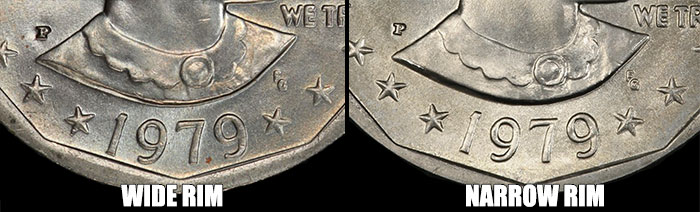
1979-P Wide Rim (Near Date) — date hugs the rim, “1” nearly touches the raised border. The most valuable 1979 SBA dollar variety.
The Wide Rim (Near Date) was an intentional design modification made partway through 1979-P production. Approximately fewer than 25,000 surviving examples are thought to exist in all grades combined. The U.S. Mint widened the rim to help differentiate the dollar from the quarter; the change took effect late in the 1979 Philadelphia mintage. All subsequent SBA dollars (1980, 1981, 1999) carry this wider rim — only on the 1979-P can you find both types.
How to Identify:
Under 5×–10× magnification, examine the gap between the “1” of “1979” and the coin's raised rim. On the Narrow Rim, there is a clear, noticeable gap. On the Wide Rim, the “1” nearly touches or just barely clears the rim. The entire date appears pressed toward the edge.
Error #2 — Doubled Die Obverse (DDO)
Doubling on LIBERTY, the date, or Anthony's portrait
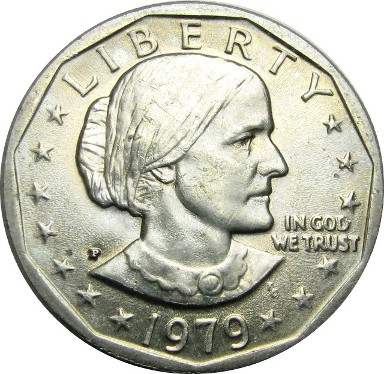
1979 SBA Dollar DDO — clear doubling visible on LIBERTY inscription or date digits under magnification.
Doubled Die Obverse errors show noticeable doubling on design elements — most commonly on the word LIBERTY, the date “1979,” or the stars around Anthony's portrait. True doubled dies show distinct notching or offset separation of letters and numbers, not blurry “mechanical doubling” which carries no premium.
How to Identify:
Use 10× magnification and focus on LIBERTY and the date. Genuine DDO shows clear separation between doubled elements — not a shelf-like extension from die wear. Compare to reference images from CONECA or PCGS CoinFacts to confirm the variety before attributing.
Error #3 — Off-Center Strike
Design shifted to one side — blank crescent area visible
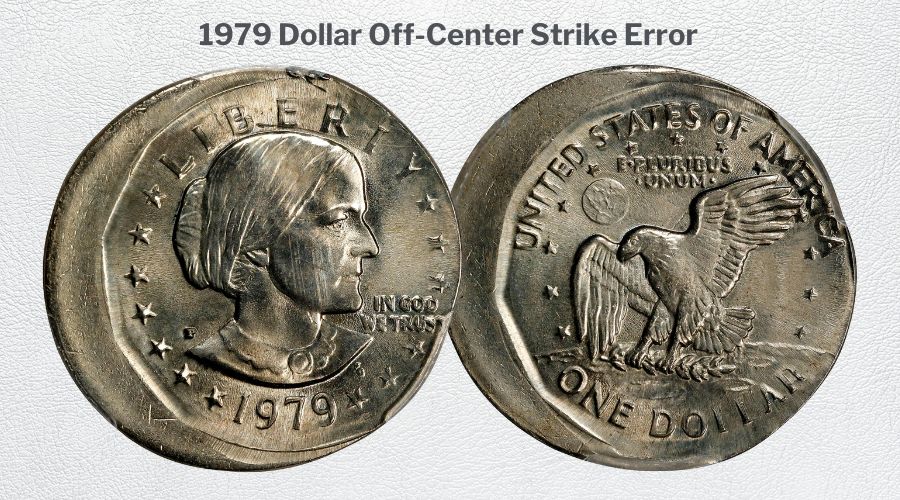
1979 SBA Dollar off-center strike — crescent-shaped blank area visible, design shifted significantly off-center.
Off-center strikes occur when the planchet is not properly centered between the dies during striking. Value is determined primarily by the percentage off-center and whether the date remains visible. A 10% off-center example with the full date is worth $50–$100; dramatic 40–50% off-center strikes with the date still visible can bring $300–$400 or more.
How to Identify:
The unstruck area should show a smooth, flat planchet surface with no design elements. The rim will only be raised on the struck portion of the coin. Measure the percentage of misalignment and check for date visibility — both factors directly determine auction value.
Error #4 — Broadstrike (No Collar)
Coin struck outside the retaining collar — larger diameter, no reeding
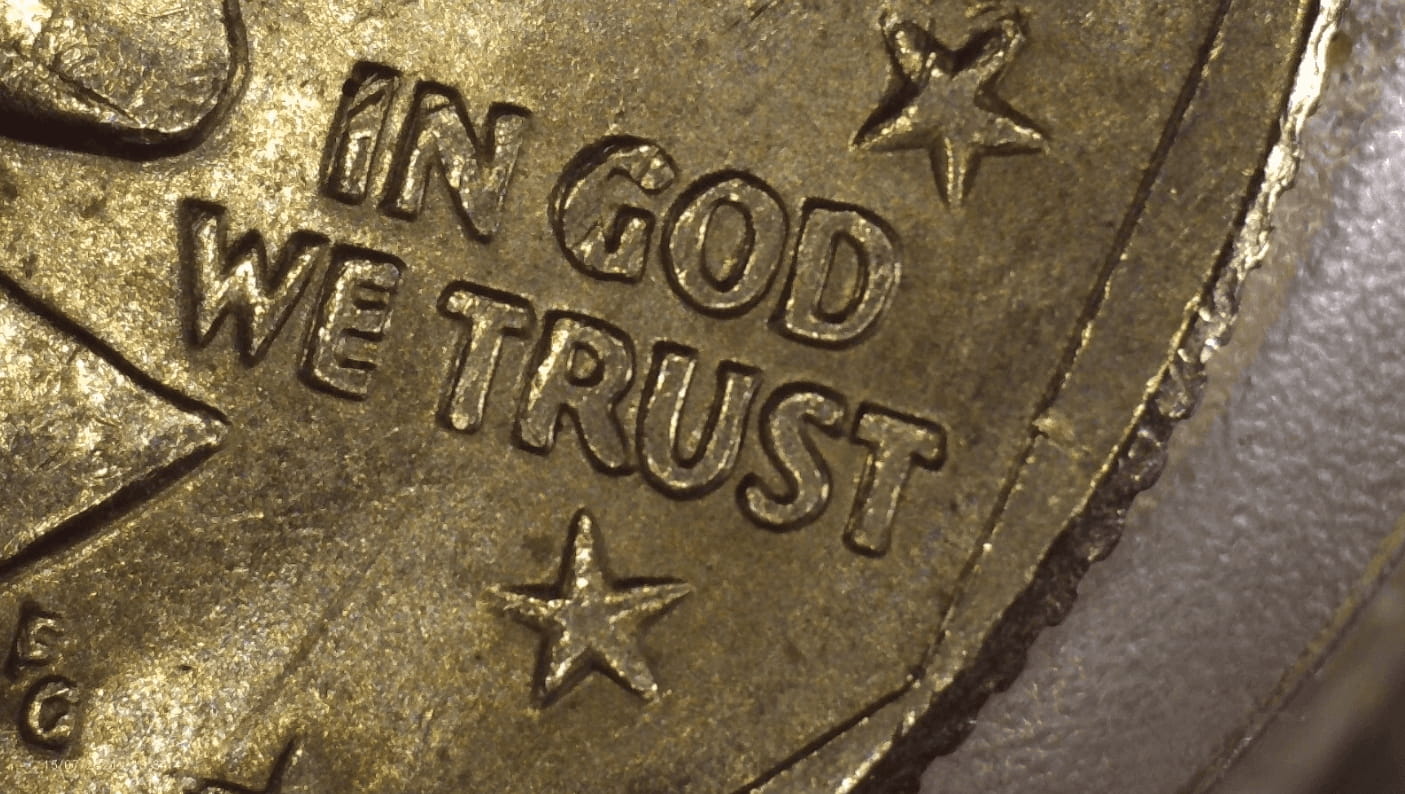
1979 SBA Dollar broadstrike — coin is visibly larger than normal 26.5mm, lacks reeded edge, rim is flat and indistinct.
Broadstruck SBA dollars were struck outside the restraining collar, producing a coin noticeably larger than 26.5mm with no reeded edge and a flat, poorly defined rim. Because of the dollar's larger size, broadstruck SBA dollars are more visually dramatic than broadstruck cents or nickels.
How to Identify:
Measure the diameter with calipers — a broadstruck dollar will exceed 26.5mm, sometimes reaching 28–30mm. The edge should be completely smooth and flat, not reeded. The rim will be flat or absent. The coin will also appear slightly thinner than normal.
Error #5 — Clipped Planchet
Missing section of edge — curved or straight clip
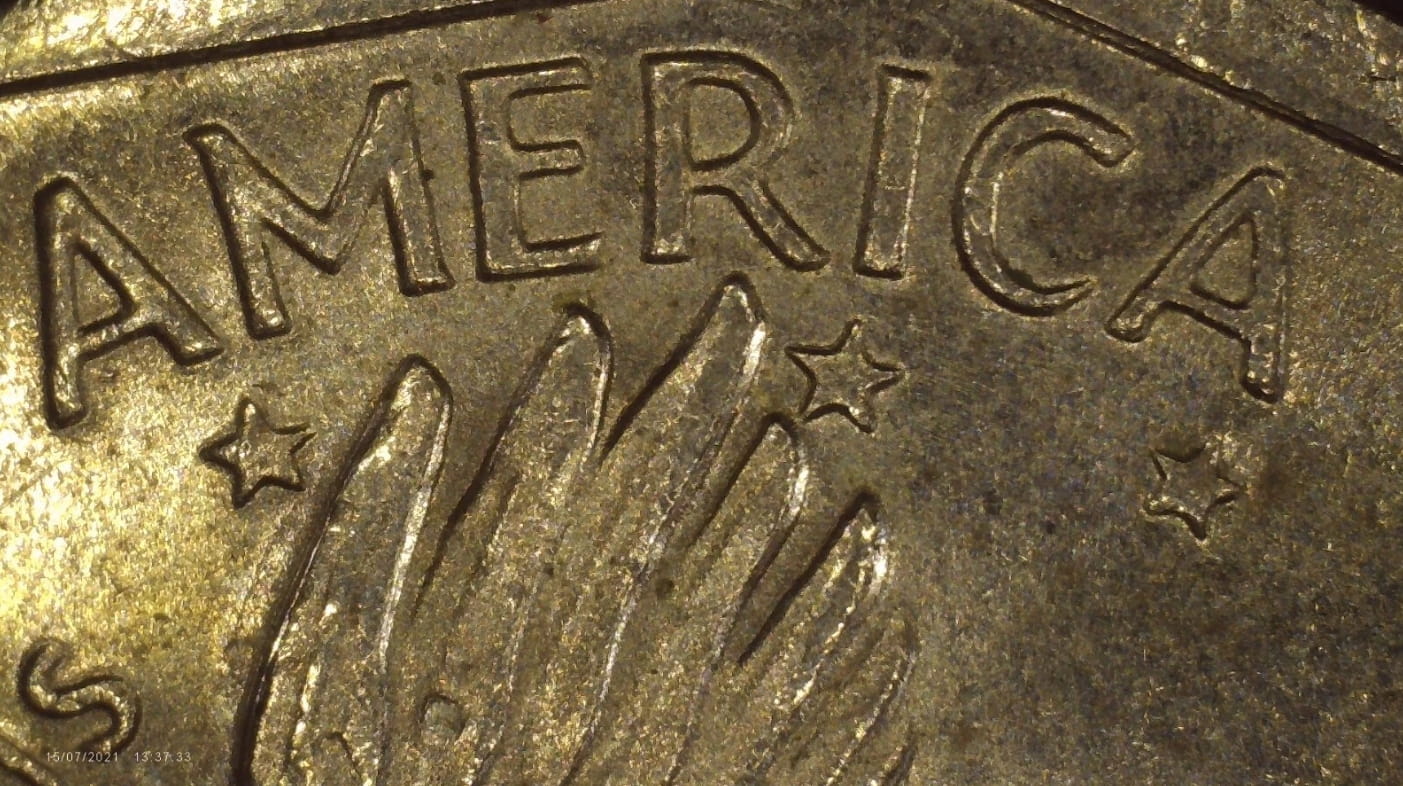
1979 SBA Dollar clipped planchet — arc-shaped section of the edge is missing, rim weakens toward the clip.
Clipped planchet errors occur when the dollar planchet blank is incompletely punched from the metal strip during the blanking process. Curved clips form an arc matching the diameter of an adjacent punched hole; straight clips occur when the punch overlapped the strip's edge. Larger clips command higher premiums.
How to Identify:
Genuine clips show smooth, factory-made edges at the missing section — not sharp breaks or cuts. The rim will be noticeably weaker near the clip. Design should extend naturally to the edge of the clipped area, proving the planchet was struck on an already-defective blank.
Error #6 — Wrong Planchet Error
SBA dollar dies struck on a planchet from a different denomination
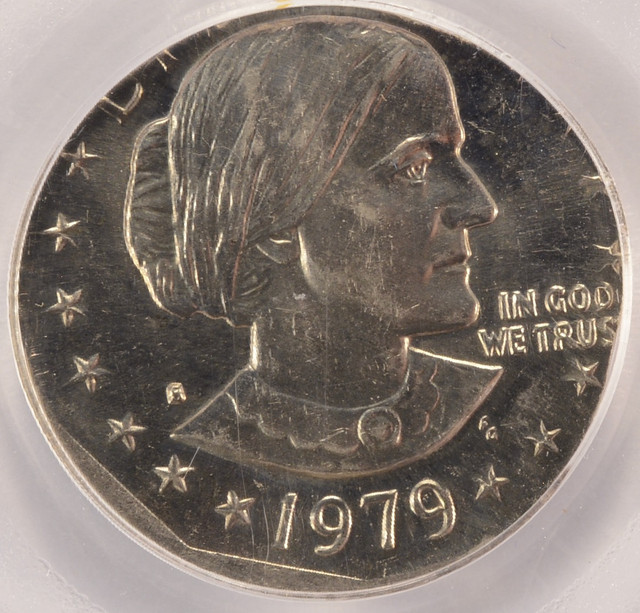
1979 SBA Dollar wrong planchet error — dollar dies struck on a smaller denomination planchet; design compressed around the edges.
Wrong planchet errors are among the rarest and most valuable 1979 SBA dollar errors. They occur when a planchet intended for a different denomination — a quarter, dime, nickel, or cent — accidentally enters the dollar coin production line. The resulting coin has the wrong diameter, wrong weight, and wrong composition. A 1979-S SBA dollar struck on a quarter planchet has been documented in the collector record.
How to Identify:
Primary diagnostic is weight — a dollar struck on a quarter planchet will weigh approximately 5.67g instead of 8.1g. A dime planchet yields ~2.27g. Diameter will also be dramatically wrong. ALL wrong planchet SBA dollars must be authenticated by PCGS or NGC before purchase or sale.
Error #7 — Die Crack / Retained Cud
Raised lines from cracks in the striking die
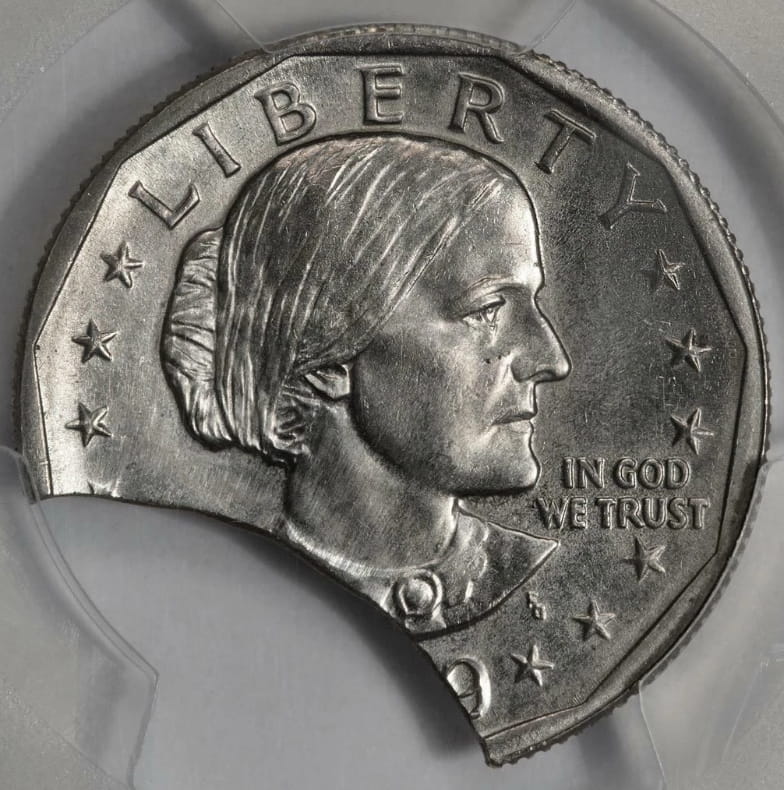
1979 SBA Dollar die crack — raised line running across the coin's surface from a crack in the striking die.
Die cracks appear as raised lines on the coin's surface caused by cracks that develop in the hardened steel die during production. Minor hairline cracks add modest value ($15–$30); major cracks bisecting significant design elements can bring $50–$150. Retained cuds — where a piece of the die has broken away entirely — are the most dramatic and can reach $300.
How to Identify:
Die cracks are raised above the surface (feel with a fingernail). Scratches are incised into the surface. Cracks will be identical on multiple coins struck from the same failing die. Retained cuds appear as smooth raised blobs at the rim where the die has fractured.
Error #8 — Strike Through / Filled Die
Foreign material between die and planchet — weak or missing design areas
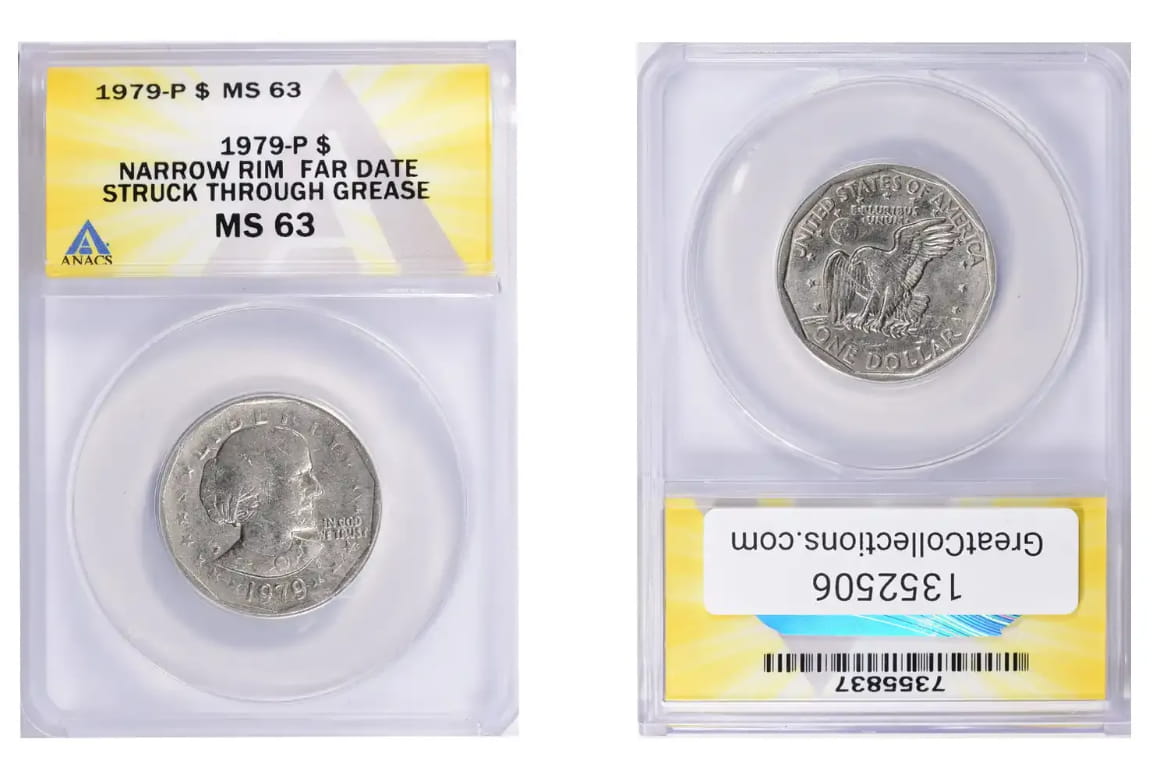
1979 SBA Dollar strike through — area of design is weakened or missing due to grease or debris between die and planchet.
Strike through errors occur when grease, debris, cloth fibers, or other material is trapped between the die and the planchet during striking. The obstruction prevents full metal-to-metal contact, resulting in areas where the design appears flat, weakened, or completely missing. Strike-throughs affecting LIBERTY, the date, or Anthony's portrait are most collectible.
How to Identify:
Examine both sides for areas where design elements look unusually flat or absent with smooth surfaces (grease) or the impressed texture of the obstructing material (cloth = weave pattern). Distinguish from wear: struck-through areas are sharp at the edges where normal design meets the blank area.
Error #9 — Type 1 Filled-S Proof (Blob S)
The common 1979-S proof — “S” mintmark worn and partially filled
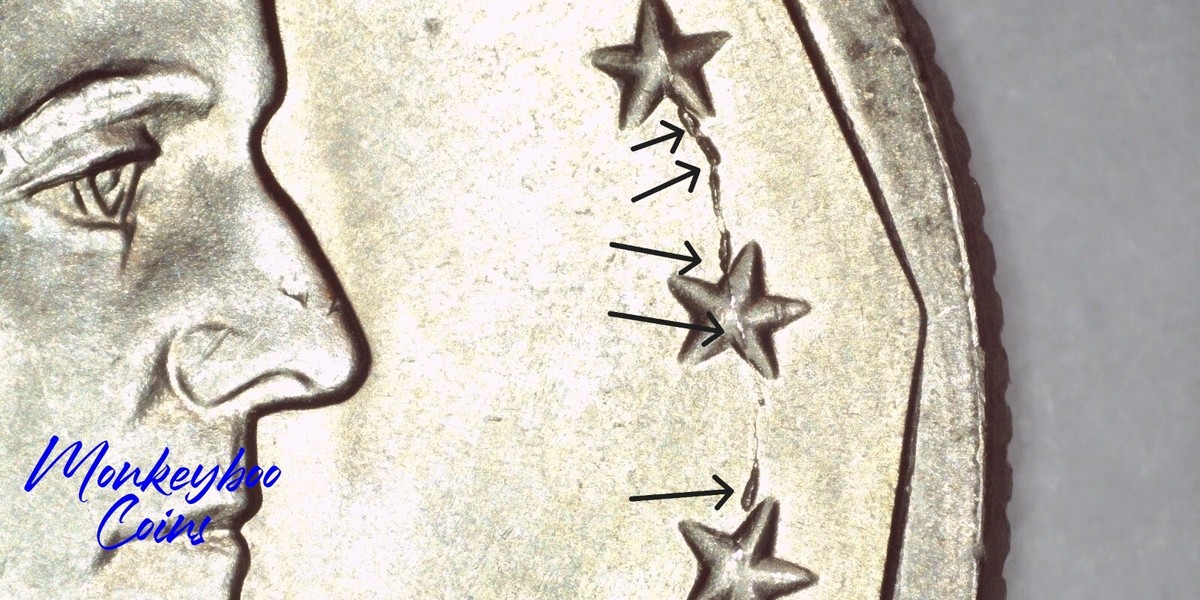
1979-S Type 1 (Filled S / Blob S) proof — the “S” mintmark appears rounded and blobby due to a worn proof die.
The Type 1 (Filled S, also called “Blob S”) is the most common 1979-S proof variety — the vast majority of the 3,677,175 proofs made that year display this mintmark. The “S” was struck from a worn die, causing the serifs and interior spaces of the “S” to partially fill with metal, creating a rounded, blobby appearance under magnification. Though technically a die defect, it is so common that it carries no meaningful premium.
How to Identify:
Under 10× magnification, examine the “S” mintmark above Anthony's right shoulder. Type 1 will show rounded, indistinct curves with the interior spaces of the “S” partially filled. The letter appears soft and heavy rather than crisp. Compare to the Type 2 (below) which shows sharp, clearly defined letter edges.
Error #10 — Type 2 Clear-S Proof
The scarce 1979-S proof — sharp, well-defined “S” mintmark
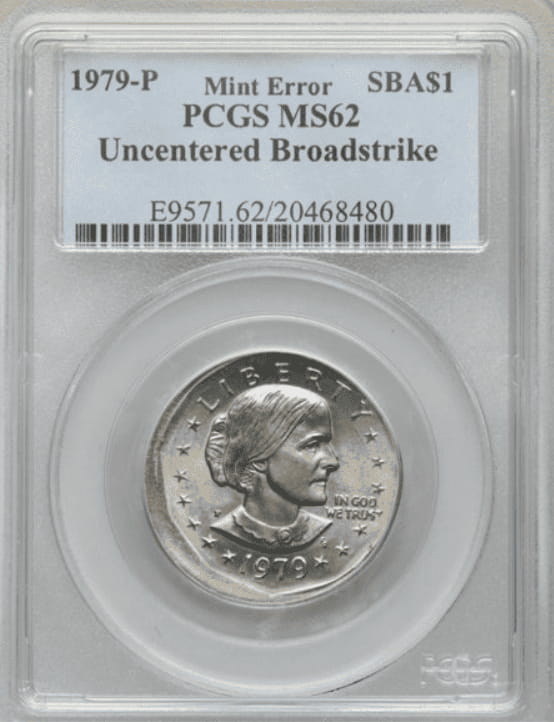
1979-S Type 2 (Clear S) proof — the “S” mintmark is sharp and clearly defined. A significant premium over the common Type 1.
The Type 2 (Clear S) is the scarce and sought-after 1979-S proof variety. Struck from a fresh, properly formed die hub, the “S” mintmark appears crisp, well-defined, and properly formed — unlike the blobby Type 1. The Type 2 was struck from replacement dies introduced partway through the 1979-S proof production run. Though found in the same 1979 Mint Proof Sets, Type 2 specimens are significantly less common and command a substantial premium.
How to Identify:
Under 10× magnification, the Type 2 “S” shows sharp, clearly defined edges with open interior spaces. The serifs are distinct and crisp. On a proof coin's mirror surface, the contrast is dramatic and unmistakable. The distinction is invisible to the naked eye but clear under even modest magnification.
Recent 1979 Susan B. Anthony Dollar Auction Results
What collectors are actually paying — Heritage, Stack's Bowers, eBay
Table 6: Notable 1979 SBA Dollar Auction Records
| Coin | Grade | Sale Price | Year |
|---|---|---|---|
| 1979-S Genuine (MS business strike) | MS65 | $15,000 | 2021, Heritage |
| 1979-P Wide Rim (Near Date) | MS67+ | $6,995 | 2021, Heritage |
| 1979-P Wide Rim (Near Date) | MS67+ | $6,463 | 2016, Heritage |
| 1979-P Narrow Rim | MS67 | $400–$500 | Recent |
| 1979-S Type 2 Clear-S Proof | PR69 DCAM | $100–$150 | Recent |
| Wrong Planchet (quarter blank) | VF Details | $800–$2,500+ | Various |
“The 1979-P Wide Rim is perhaps the best value in modern SBA collecting — a coin with fewer than 25,000 survivors that can still be found in circulation change for $1. The premium in high grades is real and well-documented.”
Best Coin Identifier App for 1979 SBA Dollars
Instantly identify Wide Rim vs Narrow Rim, Type 1 vs Type 2, and all error types
The 1979 SBA dollar presents a unique identification challenge: the Wide Rim vs Narrow Rim distinction requires magnification; the Type 1 vs Type 2 proof difference is invisible to the naked eye; and wrong planchet errors require precise weight and diameter measurements. CoinKnow's coin identifier app is designed to help collectors navigate exactly these challenges.
CoinKnow — Coin Identifier
iOS & Android · Identify Any SBA Dollar Variety in Seconds
Wide Rim Detection
Side-by-side comparison tools for 1979-P Wide Rim vs Narrow Rim — annotated close-up images showing exactly where to measure the date-to-rim gap for positive identification.
Proof Type ID
High-resolution Type 1 vs Type 2 “S” mintmark comparisons, weight and diameter guides for wrong planchet detection, and error databases covering all documented 1979 SBA dollar varieties.
Live Market Values
Real-time pricing from recent Heritage, Stack's Bowers, and eBay sold listings — covering all six 1979 SBA dollar varieties, error types, and graded population data from PCGS and NGC.
Download CoinKnow Free — Available on Both Platforms


📱 Pro Workflow: CoinKnow + Expert Grading
- Step 1: Check the mint mark above Anthony's right shoulder — P (or none), D, or S?
- Step 2: If 1979-P, examine the date-to-rim gap under 5×–10× loupe — check for Wide Rim (Near Date).
- Step 3: If 1979-S proof, check the “S” mintmark under magnification — crisp/defined = Type 2 (more valuable).
- Step 4: Weigh it — 8.1g = normal. Significantly lighter or heavier = potential wrong planchet error.
- Step 5: Use CoinKnow to photograph and compare against reference images for variety confirmation.
- Step 6: Examine both sides under 10× magnification for doubling on LIBERTY, date, or stars (DDO).
- Step 7: For any coin potentially worth $200+, submit to PCGS or NGC for authentication and grading.
The Bottom Line: Your 1979 SBA Dollar Action Plan
What to do with every 1979 Susan B. Anthony dollar you find
Final Reality Check — 1979 Susan B. Anthony Dollar
| If Your Coin Has… | It's Probably Worth… | Your Next Step |
|---|---|---|
| 1979-P or 1979-D, circulated, Narrow Rim | $1 | Spend it — face value only |
| 1979-P Narrow Rim, full mint luster | $2–$14 | Store in a coin flip — grade matters |
| 1979-P Narrow Rim, MS66+ | $30–$500 | Consider NGC/PCGS grading if MS67+ |
| 1979-P Wide Rim (date hugs rim) | $5–$7,000+ | Do NOT spend — get graded immediately |
| 1979-S proof, Blob S (Type 1) | $8–$20 | Nice collectible — store carefully |
| 1979-S proof, crisp clear S (Type 2) | $50–$150+ | Submit to PCGS/NGC for grading |
| Wrong weight (not 8.1g) or diameter | $500–$10,000+ | STOP. Wrong planchet. Submit immediately. |
| Off-center, broadstruck, clipped | $30–$400+ | Authenticate if potentially worth $200+ |
Your 5-Minute 1979 SBA Dollar Checklist:
- Check the mint mark — above Anthony's right shoulder. P (or blank), D, or S?
- Wide Rim test — if 1979-P, use a loupe and measure the gap between “1979” and the rim. No gap = Wide Rim = potentially worth thousands.
- Proof type test — if 1979-S proof, examine the “S” under 10× magnification. Blobby = Type 1. Crisp = Type 2 (premium).
- Weigh it — 8.1 grams is correct. Any significant deviation = potential wrong planchet error worth hundreds or thousands.
- Error scan — check for off-center design, missing rim/reeding (broadstrike), arc-shaped missing edge (clipped planchet).
- DDO check — examine LIBERTY and the date under 10× magnification for notching or doubling.
- Use CoinKnow — instant variety ID, error detection, and current market values from your phone.
The 1979 SBA Dollar: America's Most Controversial Coin — Still Paying Out
In July 1979, the U.S. Mint released what it hoped would be the future of American coinage — a smaller, more practical dollar coin honoring Susan B. Anthony, champion of women's suffrage. Within months, the coin was being derided as the “Carter Quarter,” confused endlessly with the 25-cent coin it was supposed to replace. By 1982, production had halted. The experiment was over.
But embedded within those 761 million “failed” coins were rarities the Mint never intended: a Wide Rim variety created mid-production and largely ignored by the public; a Type 2 proof mintmark that slipped into a fraction of that year's proof sets; wrong planchets, broadstrikes, and dramatic off-center errors that escaped quality control. Today, those accidents are worth serious money to collectors who know what to look for.
“The 1979 SBA dollar was unpopular the day it was issued. That unpopularity meant people spent them freely — which is exactly why a Wide Rim survivor in MS67+ is worth nearly $7,000 today. The coins people keep are never the ones that become rare.”
Check every 1979-P dollar you find. The loupe costs five dollars. The Wide Rim test takes thirty seconds. And finding a date that hugs the rim just a little too closely could change a one-dollar coin into the most interesting piece in your collection.
Found a 1979 SBA Dollar Worth Investigating?
Use CoinKnow for instant Wide Rim identification and error detection, then send anything potentially valuable to PCGS or NGC for professional grading.
Last updated: 2026 | Values based on Greysheet CPG®, PCGS CoinFacts, NGC Coin Explorer, Heritage Auctions, and eBay sold listings
Disclaimer: Coin values are estimates based on recent market data. Actual prices depend on individual coin condition, current demand, and auction timing. Professional grading recommended for coins potentially worth $200+.